Reviews

Etienne Guittard Soleil d’Or
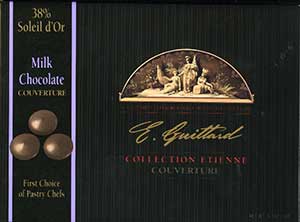
Guittard Soleil d'OrGhirardelli is the best-known chocolate maker from San Francisco, but by no means the only one. The Bay Area is very serious about food, and boasts many fine chocolatiers such as Guittard, Scharffen-Berger, Joseph Schmidt, and Michael Recchiuti, all of which uphold a much higher standard of quality than Ghirardelli (while not inedible dreck like Hershey’s, Ghirardelli is over-sweet and fairly lackluster).

Guittard is not as well known, as they used not to sell retail (their chocolate is used, among others, by See’s Candies and Boudin Bakery, and I once had a wonderful cherry and Guittard chocolate cake at Eno in Atlanta). This changed when they recently introduced a line of premium chocolates, named after the firms’s French founder, Etienne Guittard.

They probably don’t have an extensive distribution network yet, but their products are starting to trickle into finer San Francisco groceries like my neighborhood one, Lebeau Nob Hill Market (“People in the Know / Shop at Lebeau”).
Guittard new packagingI bought a 500g box of their “Soleil d’Or” milk chocolate, packaged as a box of “wafers” (little quarter-sized pieces reminiscent of Droste Pastilles). In this form, it is intended for cooking, but the bite-sized wafers are also perfect for snacking. It has a relatively high cocoa content for milk chocolate (38%, the usual is more like 32%), which gives it a satisfying taste that lingers in the mouth. This chocolate is also well balanced, it does not have the malty harshness of Scharffen-Berger milk chocolate or the milky aftertaste of Valrhona “Le Lacté”. In fact, it comes close to my personal favorite, Michel Cluizel “Grand Lait Java”, no small achievement, specially when you consider the difference in cocoa content (38% vs. 50%) and the price difference ($9 for a 500g box vs. $5 for a 100g tablet).

Update (2004-12-30):

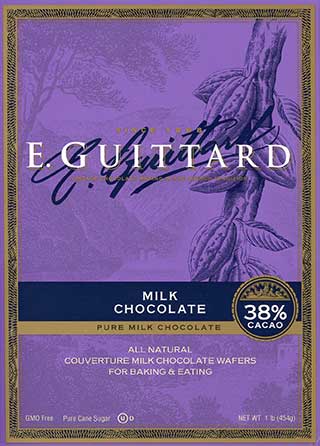
Guittard updated their packaging (shown right). The newer one is more classy and eschews the pretentious “Soleil d’Or” and “Collection Etienne” labels, but the chocolate itself is unchanged. The box is also slightly lighter (1lb or 454g vs. 500g for the older one, i.e. a 10% price increase…), but at $9.99/lb, you are still paying Lindt prices for near Cluizel quality


Amedei Porcelana

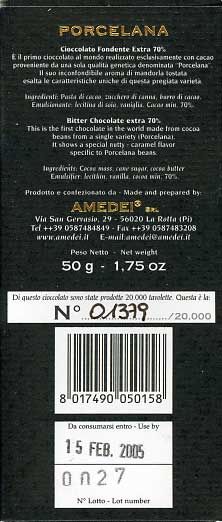
PorcelanaI recently purchased a bar of Amedei Porcelana chocolate. Fog City News sells them for $11 here in San Francisco. When a bar of chocolate is individually numbered in a limited edition, you know it is going to be expensive… There are two reasons why boutique chocolates bars made in small quantities are better than mass-produced ones.

The first one is they don’t adulterate the cocoa butter with vegetable fats (a.k.a. margarine). The European Union yielded to British lobbying efforts and allowed this indefensible practice. Not that chocolate is the only product that legendarily taste-impaired nation tampers with. I lived in London in 1982, and remember my horror at finding out that vanilla “ice cream” included such fine ingredients as fish oil…

The second one is that big manufacturers like Nestle, Kraft Jacobs Suchard, Cadbury or Lindt produce such large volumes they can only retain cocoa varietals that are also grown in large quantities in industrial scale plantations, just as McDonald’s uses standardized potatoes grown to order. Furthermore, several varieties are usually blended for homogeneity, at the expense of character (echoes of the debate between proponents of blended vs. single malt Scotch whiskey). Smaller companies or smaller production runs do not have these constraints and can purchase high-quality cocoa beans that are grown in small quantities.

Venezuelan Criollo cocoa is widely considered the finest variety. It is not as strong (some may say harsh) as Forestero varieties, but has much more refined and complex flavor. It also has poor yields, making it unsuitable for the mass market. Porcelana is the most genetically pure variety of Criollo, and like the others, has mild but incredibly subtle aromas, without the aggressive acidity of some.

I find self-proclaimed connoisseur reviews that speak breathlessly of “fantastic tangy flavor, that evolves through wine and blue cheese to almost too sharp citrus” faintly ridiculous at best, and more than a little unappealing in how they are obviously patterned on wine snobs. That said, Porcelana is definitely a superlative chocolate. I don’t think I will be feasting regularly on it, due to the price, but it is certainly worth trying on special occasions.

Keyspan USB Server review

I saw the Keyspan USB Server at MacWorld SF a few months ago, but it has only recently started to ship (I received mine yesterday). This device allows you to connect a Mac or PC to up to 4 USB 1.1 peripherals remotely over Ethernet, much as a print server allows you to access remote printers. It also allows sharing of USB devices between multiple computers.

I use it to reduce clutter in my apartment by moving away bulky items like my HP 7660 printer and my Epson 3170 scanner away from the iMac in my living room, which has progressively become my main computer, even though it is probably the slowest machine I have.

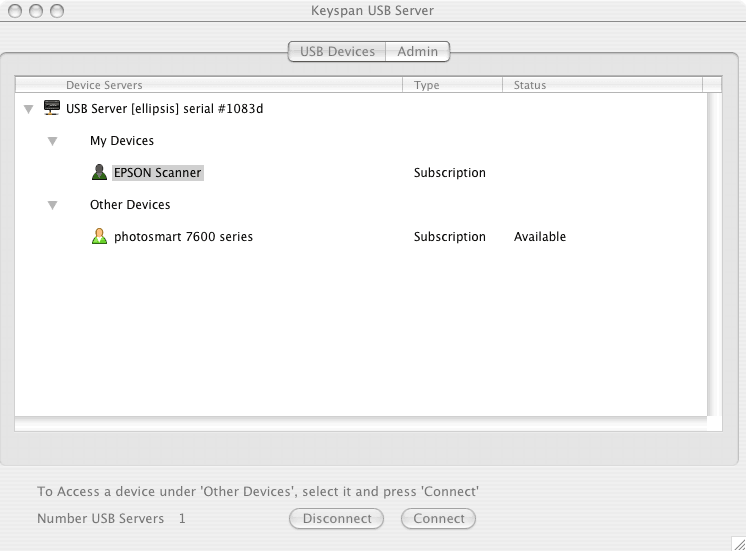
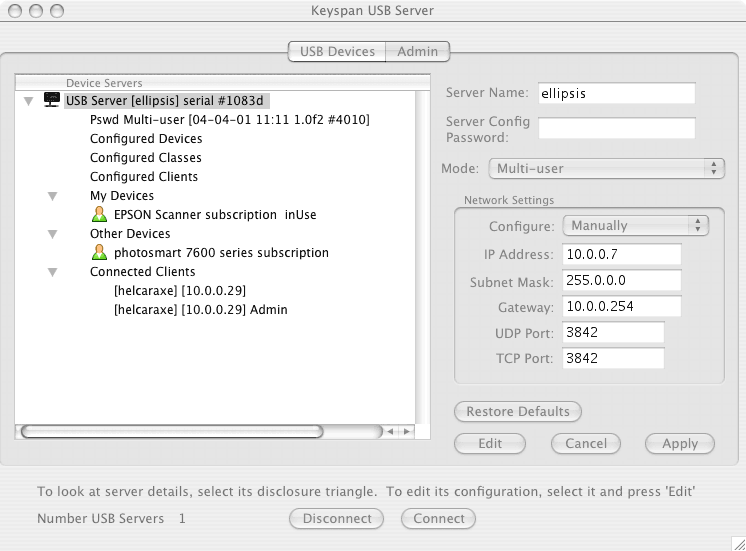
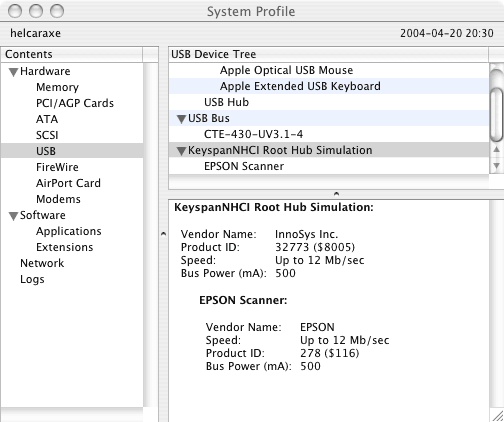
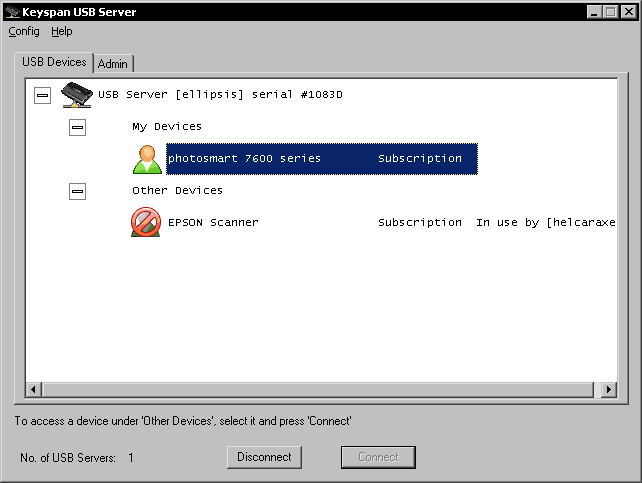
You install the driver software (Windows 2000/XP or Mac OS X, no drivers for Linux so far), and it creates a simulated USB hub device that takes care of bridging the USB requests over Ethernet. There is a management program that allows you to configure the settings on the USB Server such as the IP address (zeroconf, a.k.a RendezVous is supported, a nice touch), password and access mode. The user interface is functional, if not perfectly polished. To use a USB peripheral hooked to the USB server, you fire up the admin client, select one of the USB devices and take a “lease” on it. I have links to some screen shots of the GUI below:

The process is as smooth as it can possibly be, given that USB devices are not designed to be shared between multiple hosts, and thus some form of locking had to be provided. I tried my scanner over the Ethernet, and have not noticed any perceptible degradation in performance. The software copes with sleep mode correctly. The only nit I would have to pick is that the power adapter “wall wart” DC connector slips off the device too easily (not enough friction to hold it in place), disconnecting it.

Many families are becoming multi-computer households. The Keyspan USB Server is a surprisingly effective way to share peripherals or to move bulky and seldom used peripherals out of the way. At a street price of around $100, it is not inexpensive, but I found it a very worthwhile accessory for my home network.

Archival photography

Henry Wilhelm is a well-known authority on preserving photographs. He pretty much wrote the book on the subject, and it is now downloadable for free in PDF format from his website.

In a nutshell:

  • No widespread color process is really archival, unlike black & white
  • Fuji good, Kodak bad

Wilhelm has contributed greatly to making photographs last by raising the public’s awareness of conservation issues, at a time when manufacturers like Kodak were engaging in deliberately deceptive marketing implying that color prints would “last forever”, when they knew the prints would not exceed 10 to 15 years (Fuji has put far more effort in making their materials last).

That said, his simulated aging testing methodology has been criticized as too optimistic, and in one embarrassing instance, Epson Stylus Photo 2000 inkjet photo papers he highly rated for their durability turned out to be very short-lived because they were very sensitive to very common ozone pollution. For an alternative, more conservative, take on inkjet print longevity, Stephen Livick’s website offers a valuable counterpoint.

My take on the subject: I almost exclusively use black & white film because it has a distinct character and is archival without special equipment or active attention. Color film relies on dyes (that fade over time) rather than silver, and fades quickly or suffers from weird color shifts even when kept in the dark. The exception is Kodachrome, which keeps a very long time in the dark despite being also dye-based, but Kodak is not enthusiastic in supporting it and its future availability is uncertain. Given that, it makes more sense to use digital, which has more than caught up in quality, and at least has the potential for lasting images if managed properly (a big if: imagine you were to disappear tomorrow, would your heirs know how to retrieve your digital photos from your computer?).

And of course, I boycott Kodak, a company ruled by bean-counting MBAs whose only concern seems to be how to cut corners in silver content at the expense of product quality, much like Detroit automakers behaved before American consumers wised up to the shoddy quality of their products. Then again, Kodak’s current management is stacked with former HP executives who are turning the company into a HP-wannabe, thus predictably accelerating its slide into irrelevance.

The Cognitive Style of PowerPoint

Edward Tufte

Graphics Press, ISBN: 0-9613921-5-0 Publisher

Edward Tufte is probably the single most influential authority on communicating complex information graphically. He pretty much wrote the book(s) on the subject in his classic series The Visual Display of Quantitative Information, Envisioning Information and Visual Explanations.

In this short booklet (24 pages), he devastatingly takes to task the shoddy quality of Microsoft PowerPoint presentations, and makes the case this information poverty is intrinsic to the tool itself, due to its limitations such as low resolution (cannot use complex data), poor typography, strong bias towards hierarchical outlines and fluff over substance. In Tufte’s own words:

The PP slide format has probably the worst signal/noise ratio of any known method of communication on paper or computer screen.

This echoes one of the reasons why Sun Microsystems banned PowerPoint slides, their abysmal information per kilobyte ratio. More worryingly,

In day-to-day practice, PowerPoint templates may improve 10% or 20% of all presentations by organizing inept, extremely disorganized speakers at a cost of intellectual damage to 80%.

The booklet is short and sweet. Tufte’s wicked sense of humor comes out in comparisons to Stalinist propaganda or in a set of slides by Peter Norvig showing how PowerPoint could have denatured the Gettysburg Address.

In my experience, PowerPoint slides are mostly used to vehiculate marketing garbage presentations. As such, there isn’t much content to damage in the first place, and the act of showing a PowerPoint presentation is in itself an excellent cue to the audience that they can do their crossword puzzles, tick off their grocery lists on their Palm Pilots or whatever other discreet way is at hand to salvage otherwise completely wasted time.

Tufte’s suggestions for improving the quality of presentations (give high-content handouts, eschew PowerPoint for anything but projecting low-resolution images, and above all, do not read out slides) are mostly useful for scientific or engineering presentations, which is probably a tiny proportion of PowerPoint’s market.