Reviews

Adobe “Creative” Suite 3, a mixed bag

I installed Adobe Creative Suite 3 on my home PowerMac and my MacBook (the license allows you to install it on two computers as long as they are not in simultaneous use). The only real reason I upgraded is to get a native Intel version. I have barely started using it already and I already have peeves:

  • Bridge looks butt-ugly, is even slower than before and with a more amateurish interface than ever
  • The install procedure is incredibly annoying and Windows-like. There is no justification for an install procedure that chokes if the beta was not uninstalled officially (although I have to give some brownie points due to the fact the cleanup script is written in Python).
  • The icons are aesthetically bankrupt. What kind of credibility does Adobe think it has with creative people with such an astoundingly lackluster effort?
  • Barely installed and already in need of software updates. The widespread availability of fast Internet connections is no excuse for shoddy release management or a “we’ll patch it post-release” mentality. Speaking of which, the only proper time to interrupt users with a software update dialog is as they are quitting the application, not by getting in the way of whatever task they are trying to get done by starting up the app.
  • Don’t clutter my hard drive with legal drivel in twenty different languages. It’s called “Creative Suite”, not “Boilerplate Suite”.
  • All the tie-ins to paid add-on services like Adobe Stock Photos or Acrobat Conferencing are incredibly obnoxious, just like those for MSN or .Mac.
  • JavaScript in Acrobat is a big security and privacy risk, and should be disabled by default.
  • On the plus side, thanks for making a “Design Basic” edition without all the despicable Flash garbage in it. I would actually pay more for the Basic version than for the supposedly premium one infected with Flash and Dreamweaver.

Update (2008-01-01):

It seems Adobe has also crossed a serious ethical line by building in spyware to track on whenever a user starts a CS3 application.

As far as I am concerned, this is the last straw and I will actively start looking for substitutes for Adobe products as soon as I return from my vacation.

Update (2008-01-02):

It seems Adobe does not collect the serial number after all. The apps should nonetheless never call on the Internet except possibly to check for updates. For people like myself who have static IPs, the IP address itself could be used to correlate the analytics with personal information.

Is Vista a piece of unalloyed garbage?

As far as I can see, the answer is yes.

About a month ago, my two-year old Windows PC game machine started crashing every two minutes in NWN2. This proved the last straw, and I decided to upgrade. One of the games I have, but seldom play is Oblivion, which is graphically gorgeous, but chokes on anything but the most powerful hardware at ordinary resolutions, let alone my Apple Cinema Display HD’s 1920×1200, and cutting-edge video cards are no longer available for the AGP bus in any case.

I looked around for packaged solutions from systems integrators, specialized gaming PC companies like AlienWare, and Dell. Contrary to conventional wisdom, it is still much cheaper to build a PC from components than to buy one from a major vendor, $1500 vs. $2500 minimum. Part of the reason is that the vendors flag anyone wanting the absolute best video card as a “cost is no object” customer, add all sorts of expensive components that make no sense in a machine that will only ever be used for games, like fancy DVD burners or flash card readers to jack up the profit margins. As if anyone in his right mind would use a Windows computer for serious work like digital photography…

My configuration is the following: a relatively quiet Antec Sonata II case, an Abit KN9 Ultra motherboard, an AMD Athlon x2 5200, 2GB of Kingston DDR-800 RAM, a humongous nVidia GeForce 8800GTX video card, a 500GB hard drive and a basic DVD-ROM drive.

When it came to choosing the OS, after much trepidation I opted for Vista Home Premium because the 8800GTX is one of the few cards that support DirectX 10, which is a Vista-only feature. I knew Vista would embezzle half the processing power of one core in DRM code that is actually working against my interests, but then again nobody in his right mind would use DRM-ed formats, whether Microsoft or otherwise, to store their music library, so the damage would be limited. Also, Vista comes with “downgrade rights” which allow you to legally install the previous version of Windows.

Vista comes in an attractive copper-colored DVD that is actually quite elegant. Its color scheme is also far superior to the molten Play-Skool set monstrosity that is XP. When I started the Vista installer, I was pleasantly surprised by how quickly it dealt with hard drive formatting (the previous Windows I installed myself is Windows 2000, which will insist on a time-consuming full format instead of the quick format used by the XP or Vista installers). The good impression lasted for all of five minutes. After the inevitable restart to complete installation, the screen promptly dissolved into a scrambled red-and-white screen of doom (I did glimpse a blue screen of death shortly before it rebooted). The diagnostics were completely unhelpful, as could be expected. When the operating system cannot even install itself, you have got to wonder…

Dejectedly, I fished out a Windows XP install DVD. it would not accept the Vista serial number. So much for downgrade rights. Of course, since the package was now opened, no hope for a refund either. I ended up buying a copy of Windows XP, which installed without a hitch. Of course, I still had to install the video drivers, but it did not crash half-way through the install procedure. And Oblivion is now playable without agonizing stutters every two paces.

The 8800GTX is very recent hardware, which did not even have non-beta Vista drivers when I installed it, so I could understand the OS falling back to SVGA mode. There are no other really exotic components here, certainly nothing than XP SP2 could not deal with and therefore Vista should as well. The machine is also well within the recommended minimum configuration (although some experts now advise 4GB of RAM as a realistic minimum for Vista). Crashing during install, when a five year old OS like XP handles it just fine, is simply unacceptable in my book. Even Solaris 10 Update 3, an OS notorious for its limited hardware support, installed without a hitch. Despite the ten man-millennia Microsoft invested in this lemon, they apparently could not be bothered to test the installer.

Conclusion: unless you buy a computer with Vista pre-installed, avoid it like the plague until SP1 is out, just like Intel.

Post scriptum:

Actually, I would not even recommend a PC with Vista preinstalled, as it has terrible backward compatibility. It will not run Office 2000, which is what my company has, for instance. Joel Spolsky has an excellent article on how the new, bloatedly bureaucratic Microsoft lost its way by sacrificing backward compatibility on the altar of useless marketectures. Perhaps they are just trying to force-upgrade people to Office 2007. They should beware: unlike 2002, people have credible alternatives now.

Update (2007-08-30):

The paper about how Vista eats up CPU on DRM has been criticized by the generally reliable George You. My point about the inability to even install on a modern machine that XP has no problems with remains. In any case, having the operating system constantly eat up CPU on tasks I do not want it to, whether it is 7% or 100% of one core, is still morally no better than a parasitic botnet.
Spare the strap, spoil the camera

There are many ways to carry a camera. Most are supplied with a neck strap (and there is a non-slip shoulder equivalent, the UPstrap). Wearing a camera around the neck gets tiresome really quickly, makes you look like a goofy tourist, and potentially attracts the undesirable attention of thieves and would-be muggers.

I usually carry my camera discreetly inside a shoulder bag. A regular bag, mind you, not one of those obesely over-padded camera bags that are so bulky as to preclude walking around with them. You still need something to secure the camera, prevent it from slipping from your grasp and falling onto the hard pavement.

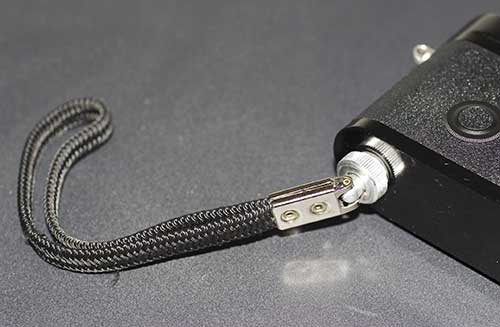
For pocket cameras, the wrist strap usually supplied will do just fine. You can get a tighter fit by attaching a cord lock (Google comes up with a bewildering variety of them) and reduce the risk of the lanyard slipping off your wrist. For some reason, only Contax had the sense to supply lanyards with a built-in cord lock.

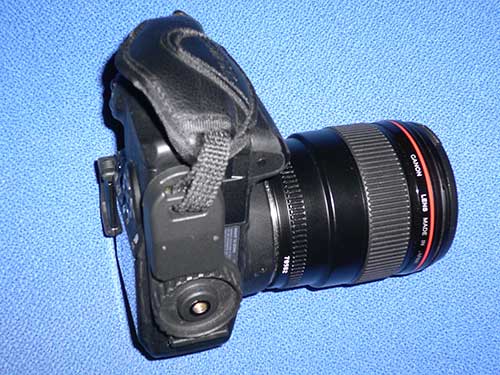
For larger cameras, you need a hand strap. They are very common with camcorders, but unfortunately, very few camera manufacturers think of offering them as an option, or even provide bottom eyelets to make attaching them convenient. You have to hunt for third-party accessories and attach them using the tripod screw mount at the bottom of the camera.

For some time, I have mounted a cheap Sunpak hand strap on my Rebel XT. It does the job, but the plastic tripod mount is flimsy and unscrews all to easily, and the vinyl is not very pleasant to the touch. Another issue is that it precludes the use of an Arca-Swiss type quick-release plate. About a year ago, I wrote to Acratech, the people who make my ballhead and the QR plate on my Rebel XT, to suggest they drill an eyelet in the plate to allow mounting a strap, but never got a reply back.

Sunpak wrist strap

I recently found out that Markins, a Korean maker of fine photographic ballheads, apparently took a patent on the idea and sells leather hand straps to go with some of their QR plates. Despite the princely price, I immediately ordered a set.

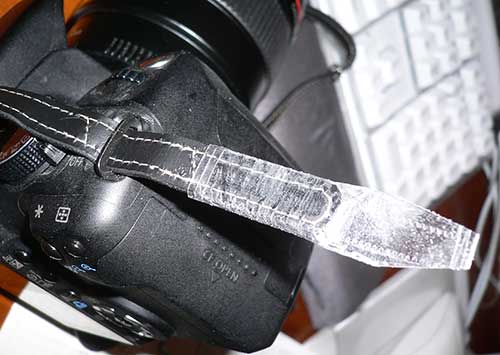
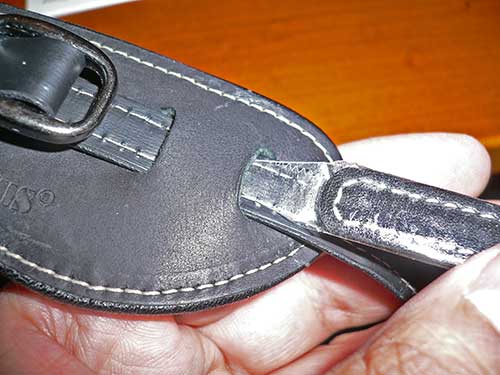
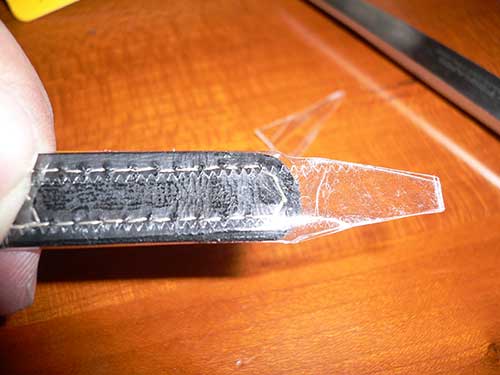
You have to unwind the strap to thread it through the eyelets on the camera and the QR plate, and back through the leather knuckle guard. This is fiendishly difficult to do if you don’t know the trick to it: wrap the tip of the strap in packing tape to produce a leader, and cut to a taper with scissors to ease insertion.

making a leader

threading through the eyelet

threading through the leather guard

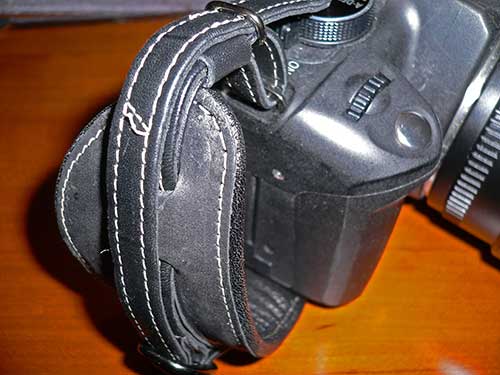
front view

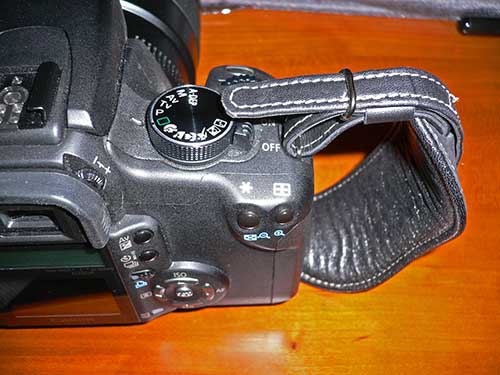
rear view

This strap works because the Rebel XT has a protruding hand grip. For a camera like the Leica MP, which does not have an ample grip (unless you attach an accessory grip), I use a sturdy strap liberated from my father’s old 8mm movie camera.

Tripod mount wrist strap on a Leica MP

If you don’t have one of these lying around, you can always try one of Gordy Coale’s wrist straps, or if they lack snob appeal, Artisan & Artist makes ridiculously fancy (and expensive) ones for Japanese Leica fetishists.

Update (2022-11-24):

I use a Peak Design hand strap on my Nikon Z7. It attaches to a standard Peak Design anchor at the bottom (in this case, attached to a RRS QR plate) and has a gate clip strap at the top that goes through an slot-type eyelet (or in this case a triangular split ring).

The San Francisco chocolate lover’s shortlist

Here are my picks for the best chocolate places in the city (note: updated 2013-04-20):

  • Chocolate merchants: Noe Valley’s Chocolate Covered has made leaps and strides in the last 5 years, and beat previous favorite Fog City News
  • Honorable mentionFog City News, an impressive lineup tended by the knowledgeable owner, Adam Smith. Also the chocolate section at Rainbow Co-op.
  • Chocolate bouchées: Cocoa Bella. This shop is a chocolate integrator: it collects chocolates from small chocolatiers across the world and brings them under a single roof. They also make hot chocolate.
  • Honorable mention: Michael Recchiuti makes scrumptious confections, and his burnt caramel chocolate covered hazelnuts are to die for, as are many of his bars. Try also his Chocolate Lab in the Dogpatch for a cafe experience.
  • Chocolate maker: Guittard. This fourth-generation family of chocolatiers, originally from France, have been supplying professionals like Recchiuti for a century and half. The best dessert I ever had in America was a Guittard chocolate and cherry cake at Eno in Atlanta, of all places. They now have a retail line of very high quality.
  • Dishonorable mentions:
    • Scharffen-Berger: part of the evil Hershey empire, who are lobbying to have FDA standards watered down (so mockolate made with margarine can be passed off as real chocolate)
    • Tcho: overrated, and very simplistic, although their “Tchunky Tchotella” bar is amusing
    • Dandelion: sleazy hipster outfit that turns good raw ingredients into crude dreck
    • L’Amourette: another overrated local brand. The packaging for their “70% Dark Chocolate Gold” screams “Venezuela” and “Sur Del Lago”, but only mentions in small type they use the inferior Trinitario cacao instead of the noble Criollo the provenance (and price) would imply.
  • Hot chocolate: Christopher Elbow on Gough & Hayes has an intense hazelnut-flavored hot chocolate.
  • Honorable mention: Charles Chocolates (disclaimer: I am an investor)
  • Chocolate pastries: Cafe Madeleine, a.k.a. Jil’s Patisserie, formerly of Burlingame, now made in their New Montgomery Street shop (with two additional locations on California and O’Farrell).
  • Honorable mentions: Miette in the Ferry Building. Tartine’s chocolate hazelnut tart. B Patisserie’s chocolate Kouign Amann.

See also my Google map of the best sweet treats in San Francisco